
Notes on the Lost Lambs Discourse; or, the Banality of Marketing

I’ve observed the Lost Lambs discourse on Notes from the sidelines for a couple of weeks now, reading and “liking” notes and comments both from deBoer and his apologists as well as from those who have disagreed with his claims (Becca Rothfeld, BDM, Garth Greenwell, et al). I finally got around to reading deBoer’s full post on the Lost Lambs blitz and felt compelled to weigh in with a few observations.
Quick, obligatory throat-clearing. I haven’t read a single one of the books mentioned below. All that I’ve read by any of the primary authors mentioned are deBoer’s essays (which I tend to like) and a short story by Cash (which I reviewed lukewarmly).
Publishers pay an advance when they buy a book (prospective or completed). The size of the advance correlates, roughly, to their expectations for its sales and their willingness to invest in its publicity. This is to say that, before a book is necessarily even completed, before anyone other than a few people have read the book, its amount of publicity (or, more precisely, the amount of resources put into its publicity) has been somewhat determined. A movie analogy: when a studio invests $100 million in producing a film, they are largely already deciding that they will release it to 4,000 theaters regardless of its quality.1 Between advertising, PR, and publications’ desire and responsibility to report on the movies that will be playing in most people’s local theaters, this movie will get a lot of coverage and many reviews—probably more coverage and reviews than the absolute best film that only gets a NY/LA release. I have never heard someone in the film community refer to this as a scandal, nor do I think many intelligent people believe Justin Tipping’s HIM got more coverage than Carson Lund’s Eephus because Tipping’s film is a greater work of art than Lund’s.
Publishers determine the size of the initial print run on speculation (and likewise in rough correlation with the size of the advance). This is to say that, before a book has been covered or reviewed, before anyone other than a few people have read the book, its publicity has been somewhat determined. If I have 100k of one product and 50k of another, I am economically incentivized to put more effort into the marketing and promotion of the former product.
Every press, from the Big 5 to Coffee House, has some version of a marketing/PR department and a set of strategies for publicizing the book. These strategies are not classified information. Below are the marketing plans for Lost Lambs on its Edelweiss page:

Let’s parse. “National media campaign: features, reviews, interviews, essays.” This may sound like the kind of conspiracy deBoer is talking about, but a “national media campaign” is a marketing strategy for most literary fiction—it simply means that they are going to put resources into trying to obtain coverage and reviews. The extent to which those efforts will “take” is, I think, only so much within a press’s control. Below are the marketing plans for Addie Citchens’ Dominion, a debut novel published by the same press (FSG) last year, with the same initial print run of 100k.

As you can see, many of the same plans. Citchens’ novel was reviewed in the New York Times and the Atlantic (both mixed reviews, according to Lithub), but didn’t seem to get the same amount of early attention as Lost Lambs. It has a respectable 5,000+ Goodreads ratings, whereas Lost Lambs already has 4,000+. Cash’s 2023 story collection, Earth Angel, published by the tiny CLASH books, has 1,700 ratings, FWIW, which is an impressive number for an indie collection of stories. That’s more, in fact, than the NBA-nominated Jamel Brinkley’s second collection Witness (2023), published by…FSG.2
And lest we think “campaign” a nefarious word, here are the marketing plans for deBoer’s The Mind Reels:3
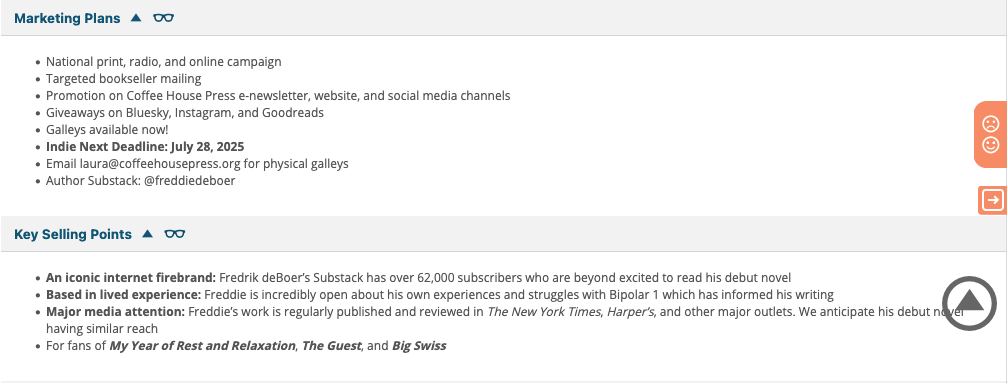
Obviously I am not comparing the resources behind FSG’s promotion of Cash’s (and Citchens’) novel and those behind Coffee House’s promotion of deBoer’s. But I’m not sure that what deBoer is arguing is ultimately more substantial than “books are commodities; larger presses have more resources to promote their books than smaller presses; culture publications will pay more attention to books published by larger presses than those by smaller presses.” One of deBoer’s frequent rhetorical moves is to point out that people will simultaneously deny that an inconvenient claim is true and assert that of course it’s true but who cares (or “duh”).4 Well, I think the above argument is true. I also think it’s rather banal, obvious. I don’t think its being obvious makes it beneath the level of discussion, but I think deBoer makes a number of ancillary insinuations that one can object to without objecting to the above core argument.
An interesting bullet from the FSG novels’ Marketing Plans is “Influencer outreach.” Is this perhaps a smoking gun of nepotism? Code for “pull a few favors to get that profile in Vogue”? It’s either not as nefarious as it sounds or virtually universal. deBoer mentions Vincenzo Latronico’s Perfection (NYRB, 2025) as a book by a youngish author that generated “organic” publicity. Let’s check out NYRB’s marketing plans for the novel when it was first published:

What’s funny here is how specific and unabashed the publicity strategies are outlined. Rather than “Influencer outreach,” we get specific writers to whom NYRB intends to pitch the novel. Somewhat sloppily, we are then informed that Oyler doesn’t really need pitching—she’s Latronico’s friend, and is going to help promote the book at an event! In fact, Oyler provided a(n obviously not disinterested) blurb for the book, as did such big names as Sheila Heti and Lauren Groff. The excerpt pitches never panned out, though the novel did get a review in the New Yorker timed to its release.
Obviously, pointing out that the buzz for Perfection is perhaps less organic than deBoer surmises does not prove that Lost Lambs did not receive extensive coverage by fiat from a shadowy cabal, but I do think it helps demonstrate how normal it is for publishers big and small to play whatever angle they can to publicize and (thereby, hopefully) sell their book.
The two bits of deBoer’s post that puzzle me the most are his definition of “success” (in the title) and the claim that Cash has been “allowed to cut the line.” The two main measures of success within literary fiction would seem to be acclaim (in terms of criticism and awards) and sales. deBoer doesn’t outright claim that positive reviews have been “purchased,” and I don’t think there’s any evidence to suggest it. The reviews, in fact, have not been extraordinarily strong. Rarely does initial publicity align with the major awards, and I’m not sure there’s any evidence that awards are “fixed.” That leaves sales, which as others have noted, are much too fickle (and frankly low-stakes) in literary fiction to be purchased with publicity and coverage. As for cutting in line—there are no lines in culture and never have been. I’m not even sure we would want there to be if I’m understanding the analogy correctly. Should artists who have been practicing their craft for longer be shown priority? If deBoer means is using “line cutting” somewhat vaguely, however—that she has cut in line by being given initial coverage that exceeds the merit of the work (or her reputation as an author)—that seems naive and petty. deBoer’s novel surely got more promotion than another Coffee House (or other small-press) novel in part because of his platform and/or the Discourse value of his book—in fact, a quick search shows that Makenna Goodman’s Helen of Nowhere (Coffee House, 2025), which I had never heard of, was not reviewed in the New York Times, nor was it reviewed in enough significant venues to have been tracked by Lithub’s Bookmarks. I don’t think this disparity in coverage between deBoer’s novel and Goodman’s is due primarily to the superior quality of one, nor do I think it to be a conspiracy or deBoer having compromising photos of Gilbert Cruz. But deBoer has effectively cut Goodman in the same sense that Cash has cut him in line, if not to the same degree. Perhaps Goodman is a little resentful, but I would tell her what I am arguing here, that such “line cutting” is largely impersonal, arbitrary, and systemic (in the sense that the system guarantees a few books get most of the coverage and most get little)—not engineered by a cult of elites choosing which books will be successful (unless that is your gloss of “marketing”). Nepotism, privilege, back-scratching all play a part in success (as deBoer admits about his own early beginnings as a writer), but in much smaller, messier ways than the form of conspiracy theories can contain.
There are occasional rule-proving exceptions in which studios’ faith in an investment plummets so far that the film is released with minimal advertising or altogether shelved.
Interpret these facts how you want, but to me it demonstrates that where your book is published and the marketing put into your work is a significant but not “determinative” factor of whether your book will “succeed” in any sense of the word (attention, reviews, sales, awards).
I also included the Key Selling Points (which FSG doesn’t provide for Lost Lambs) to highlight how much “platform” has become part of the marketing decision-making even at a little press like Coffee House. It also underscores that Substack is not extricable from the world of (non-self-)publishing.
This isn’t a dismissal—I think he’s right in many contexts!